Growing Room
One number in. Four answers out.
A size, the millimetres it leaves in front of the toes and why, a range of months rather than a promise, and a date to measure again that we will never turn into an email.
Step 1 — the measurement
Measure with the child standing, weight on the foot. Measure both feet and use the longer one.
Step 2 — what we would send
Recommended size
EU 25
Room in front
12 mm
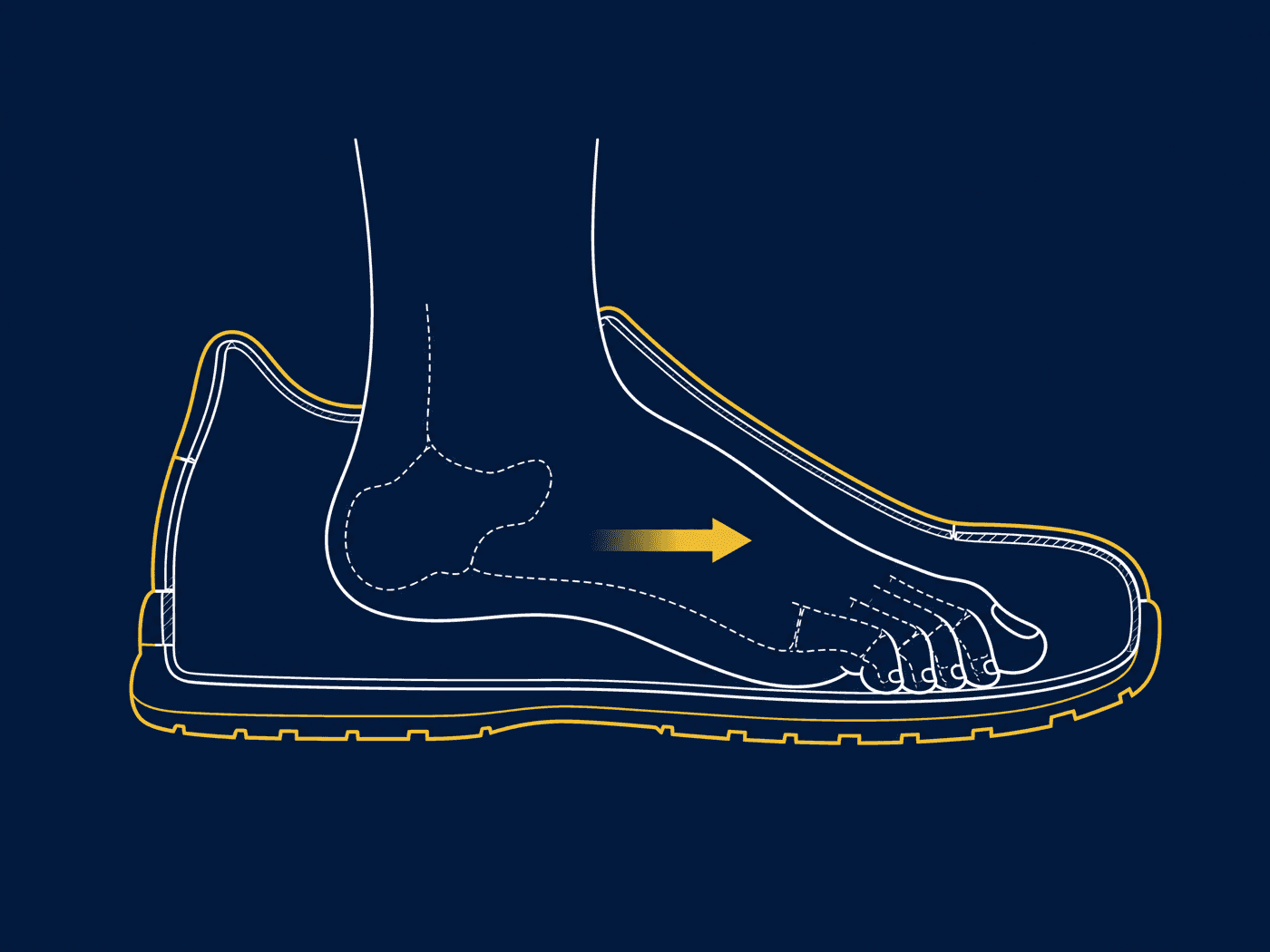
Everyday Kids shoes are built with 12 mm of allowance. 12 mm covers a normal stride plus a few months of change, without leaving enough room for the foot to slide.
- Likely wear time
- 7–12 months
- An estimate, not a promise. Children grow at very different rates.
- Measure again in
- 10 weeks
- Written here for you to note down. We will not email or notify you about it.
We don’t recommend more than one size above the measured fit. Too much room makes the foot slide forward and the toes grip.
The same foot across the range
A 155 mm foot is not one number. Rain boots are sized over a thick sock and sandals are worn without one, so the recommendation moves.
| Line | Allowance | Recommended | Inside length |
|---|---|---|---|
| First Walkers | +10 mm | EU 25 | 167 mm |
| Everyday Kids | +12 mm | EU 25 | 167 mm |
| School Shoes | +12 mm | EU 30 | 200 mm |
| Sandals | +8 mm | EU 25 | 167 mm |
| Rain & Winter | +14 mm | EU 26 | 173 mm |
These two numbers stay in your browser while you use this page. If you send them to us with an order we keep them for at most 12 months, use them only to pick a size, and delete them if you ask. We never use them to build a profile or to target advertising, and we never send you a reminder based on them.
Measuring, properly
Two details decide whether the number is any use: the child has to be standing, and you have to measure both feet. Everything else is just a ruler.
 01
01Stand on paper
Tape a sheet to a hard floor with the heel against a wall or a skirting board. The child stands up, weight on the foot. A loaded foot spreads and lengthens; that is the foot the shoe has to fit.
 02
02Mark both ends
One line at the back of the heel, one at the end of the longest toe — which is often the second one, not the big one. Keep the pencil upright and the lines square to the paper.
 03
03Measure, then do the other foot
Read the distance between the two lines in millimetres. Then repeat on the other foot. Most people have one foot longer than the other; use the longer number and forget the other one.
If the two feet differ by a lot
A few millimetres between feet is ordinary. Size to the longer foot and let the shorter one have a little extra room; the reverse leaves one foot in a shoe that is genuinely too short.
If the difference is large enough to worry you, that is a question for a healthcare professional rather than for a shoemaker.
No ruler in the house?
The paper gauge is a printed sheet with a folded heel stop and a millimetre scale. Buy the card version, or print it at home at 100 % scale — the sheet has a control square on it so you can check your printer has not shrunk it.
The part most shops leave out
What too much room actually does
A shoe that is one size too big is a shoe with an extra 6 to 7 millimetres of empty space in front of the foot. At every step the foot slides into that space, the heel lifts away from the back of the shoe, and the toes curl to keep the shoe on.
Two sizes too big doubles it. That is why this calculator will show you what two sizes up would mean, and then tell you not to do it.
We describe how our shoes are made. We don't give advice about your child's feet. If you have concerns, ask a healthcare professional.